

ETR-Sa
ETR-Sa
Couldn't load pickup availability
ETR-Sa – Product Description
-
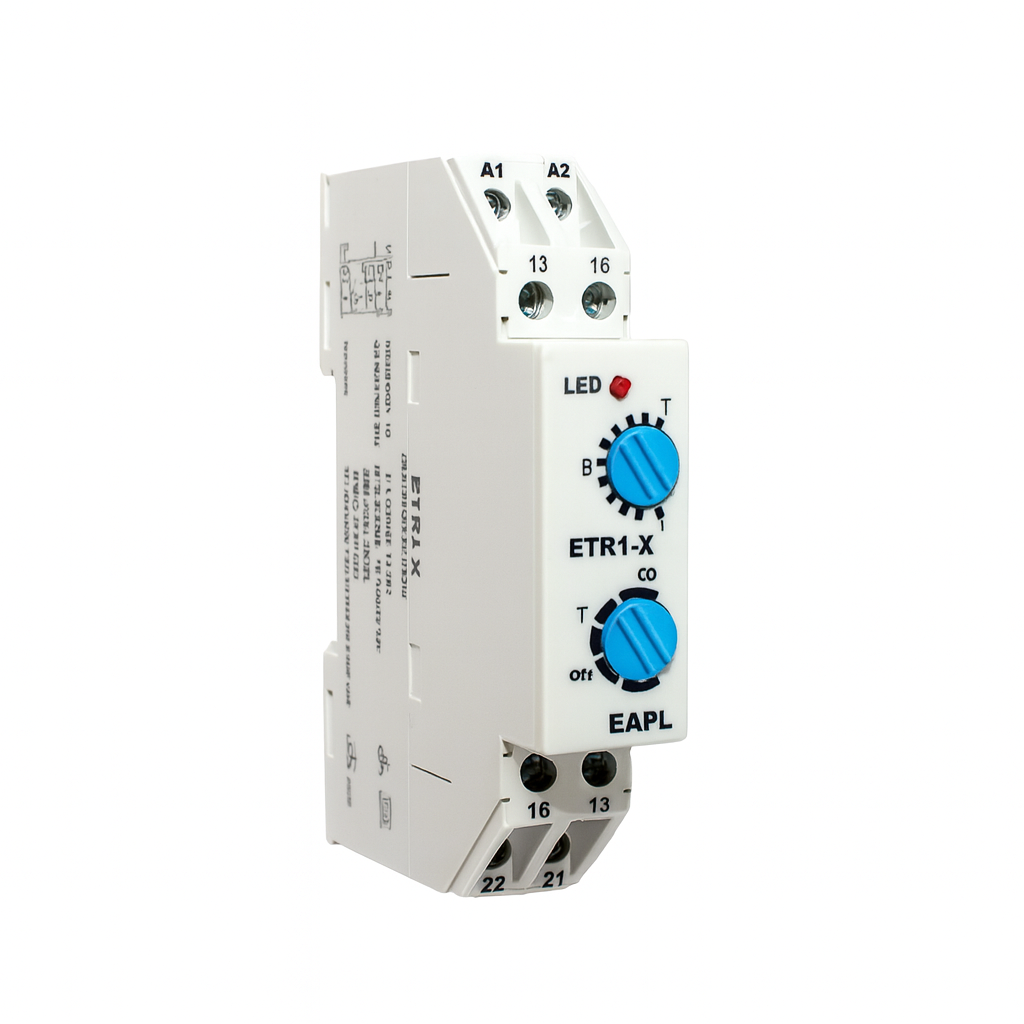
The ETR-Sa is a Star-Delta Timer designed for controlling motor starting sequences.
-
Provides an extended star timing range compared to the standard ETR-S model.
-
Compact 17.5 mm DIN-rail mounted design with LED timing indication.
-
Built with finger-guard protection and robust construction for industrial use.
Key Specifications
-
Function: Star-Delta timing control with adjustable star time and fixed transfer delay.
-
Star Time Range: 12 seconds to 120 seconds.
-
Transfer Delay: 100 milliseconds between star deactivation and delta activation.
-
Output Contacts: Two change-over (C-NO) relays – one for star and one for delta.
-
Supply Voltage: Available in standard 240 VAC; X-Version supports 24 VAC to 240 VAC and 24 VDC to 220 VDC.
-
Power Consumption: Low, in line with compact analog timer designs.
-
Terminals: Screw-type with self-lifting clamps.
-
Mechanical Life: ≥10 million operations (no load).
-
Electrical Life: ≥1800 operations/hour (at full load).
-
Insulation Resistance: >100 MΩ at 500 V DC.
-
Dielectric Strength: 1.5 kV AC between input, relay, enclosure; 1.0 kV AC across non-continuous relay contacts.
-
Dimensions: 17.5 mm (W) × 89 mm (H) × 62 mm (D).
Applications
-
Star-delta motor starting to reduce inrush current.
-
Motor Control Centers (MCC).
-
High-tension (HT) and low-tension (LT) panels.
-
Control & Relay (C & R) panels.
-
Relay Timing Control Centers (RTCC).
-
Transformer control panels.
-
Industrial automation systems where extended star timing is required.
Summary
-
The ETR-Sa is a compact star-delta timer with extended star timing (12–120 s).
-
Ensures smooth motor starting with a fixed 100 ms transfer delay.
-
Features dual relay outputs and wide supply voltage compatibility.
-
Reliable, long-life design suitable for MCCs, HT/LT panels, RTCC, transformer and automation panels.
-
Technical Support
-
Request a Quote
Request a Quote -
Dubai Based
Need Help Selecting the Right Product?
Our team can assist with product selection and technical requirements.